

Sometimes the secret to improving productivity isn’t working harder or faster. It’s finding the one constraint holding everything else back.
There’s something deeply satisfying about making things more efficient. Cutting out unnecessary meetings (ie, all of them). Streamlining processes. Getting people to work smarter and faster.
Who wouldn’t want that?
I know that when I was running systems, I was forever drawing flowcharts to see what could be done better.
Perhaps I should have spoken to Israeli physicist called Eliyahu Goldratt.
In 1984, Goldratt published The Goal, a novel about a factory manager, Alex Rogo, who has three months to turn around his failing plant or face closure.
The Goal became one of the most influential management books ever written.
As an aside, it’s interesting that Goldratt sidestepped a conventional management textbook, full of diagrams, processes and productivity ratios. Instead, he told a story.
And, as you know, we at Ravengate love stories.
He recognised something fundamental about how people learn. Give someone a management formula and they’ll probably forget it. Give them a factory manager trying to save his business and the principle becomes something they can experience.
But we digress. Back to business.
The problem with making everything better
Goldratt’s central idea, the Theory of Constraints, challenges something we tend to take for granted.
Making everything more efficient doesn’t necessarily make the whole operation more efficient.
In fact, sometimes it makes things worse.
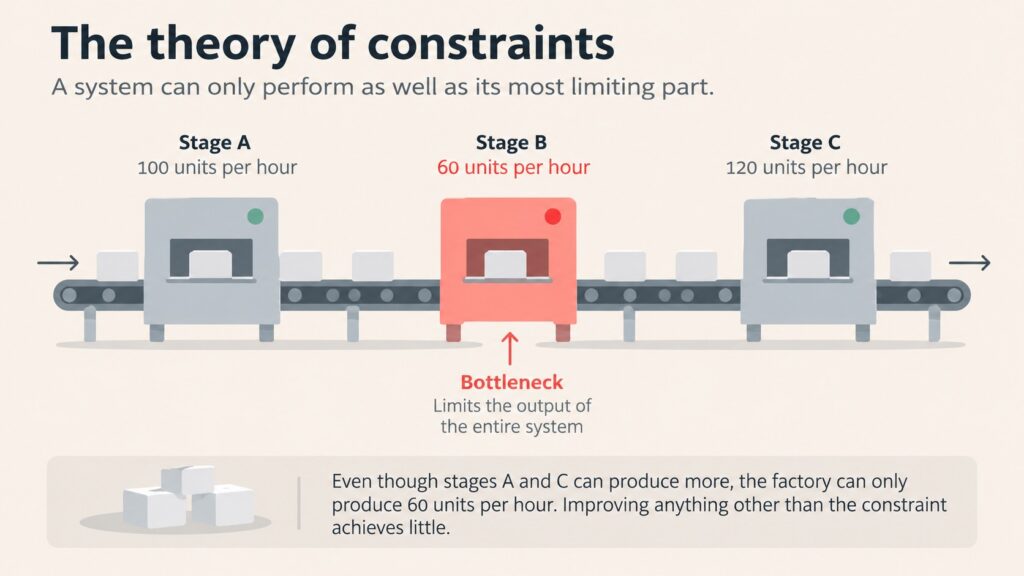
Imagine a factory with three machines. The first produces 100 widgets an hour. The second manages 60. The third can produce 120.
Your instinct might be to improve all three. Buy better equipment. Increase productivity. Get everyone working at full capacity.
But here’s the problem.
Your factory can only produce 60 finished widgets an hour because that’s all the second machine can handle. The chain, the saying goes, is only as strong as the weakest link.
Double the output of the first machine and you’ve achieved precisely nothing.
It’s the second machine. The second machine is the constraint. The bottleneck. The thing holding everything else back.
Find the bottleneck constraint. Then fix it.
Goldratt proposed five steps.
- Identify the constraint.
- Make the best possible use of it.
- Organise everything else around it.
- Increase its capacity.
- Then start again, because another constraint will inevitably emerge.
The interesting bit is that third step. The counter intuitive one, where the weakest point gets all the glory.
Goldratt called it subordination.
It’s absolutely key.
Everything else must work in support of the constraint. Not at its own maximum capacity. Not according to its own performance targets. But at whatever level helps the whole system function most effectively.
This is almost heretical.
We’re conditioned to believe that everyone should be busy, every department should maximise output and every spare minute represents wasted productivity.
Goldratt suggests otherwise.
Busy isn’t the same as productive
Consider a newsroom (as I did on sleepless nights).
Reporters produce stories. Sub-editors prepare them. Pages are designed. The newspaper goes to press.
If the sub-editing desk can handle 20 stories an hour, encouraging reporters to produce 40 doesn’t create a better newspaper.
It creates a queue.
- Why unSmart goals are worse than no goals at all
- Marginal gains: Why changing the little things can make a big difference
Worse, it creates pressure, mistakes and delays. Everyone is working harder. The newspaper isn’t getting any better.
And sometimes the constraint isn’t a person or a machine. It’s a rule, an approval process or a management decision.
More often than not it was something introduced years ago, probably as a workaround which became a habit which became a convention which became a necessity. Now it obstructs the very thing it was supposed to improve.
I wrote about that here in 2022 – my principle of SSS, Stop doing the Stupid Stuff.
The whole is what matters
What appeals to me about the Theory of Constraints is its refusal to confuse activity with achievement.
It’s not about squeezing more from everyone. It’s about understanding how everyone’s work fits together.
And recognising that improving one part of an organisation can actually damage another. Too many cooks etc.
The question isn’t whether your people are working hard enough.
It’s whether all that hard work is making any difference, whether they fit together and complement each other.
There’s no point making the wheels turn faster if the machine can’t keep up.
That’s The Goal.