
You can give your big idea the grandest name imaginable. But history may prefer the one coined by the bloke taking the mickey.
Posterity can be cruel.
History belongs to the leg-pullers, the critics and the bullies.
They get the final word.
You can spend years constructing an elaborate account of what you are doing, dive deep into the minutiae and rationale, only to discover that history prefers the name supplied by someone taking the mickey.
Er, thanks a bunch Louis
The Impressionists discovered this early.
They weren’t the Impressionists. They were the Anonymous Association of Painters, Sculptors and Engravers.
Then in 1874 the critic Louis Leroy saw Monet’s Impression, Sunrise, decided the whole thing looked unfinished and mocked them as “Impressionists”.
Thanks, Louis.
The insult became the movement. Nobody goes to the National Gallery hoping to see a nice Anonymous Association of Painters, Sculptors and Engravers.
The mockery was simply better branding.
It keeps happening.
Daytime radio serials in 1930s America were sponsored by soap manufacturers and filled with extravagant emotional drama. Somebody started calling them “soap operas”.
It was not entirely complimentary.
It was, however, perfect.
Ninety years later, television executives can talk earnestly about continuing drama, but the rest of us are watching soaps.
Italian film-makers produced their own Westerns. Critics called them spaghetti Westerns. What might have remained a slightly sniffy dismissal now describes an acknowledged film genre containing some of the most celebrated Westerns ever made.
Art history is littered with the same wreckage. Gothic meant barbarous. Baroque carried associations of deformity and excess. Cubism reduced an artistic revolution to: lots of cubes.
The mickey-takers keep winning.
He who laughs last, secures the naming rights.
First, prick the pomposity
Perhaps there is a reason.
Belief systems are particularly prone to excess. The people inside them have complex back stories, deeply held convictions and entire systems of understanding. They want you to understand all of it, at once. They are earnest, frequently pretentious and often, well, dull.
So they produce lists and codes and rules. And names.
Especially names.
They want nuance, significance and, if we’re unlucky, a paradigm. They add meaning because they desperately want us to understand that this thing is important. Perhaps more important than it looks.
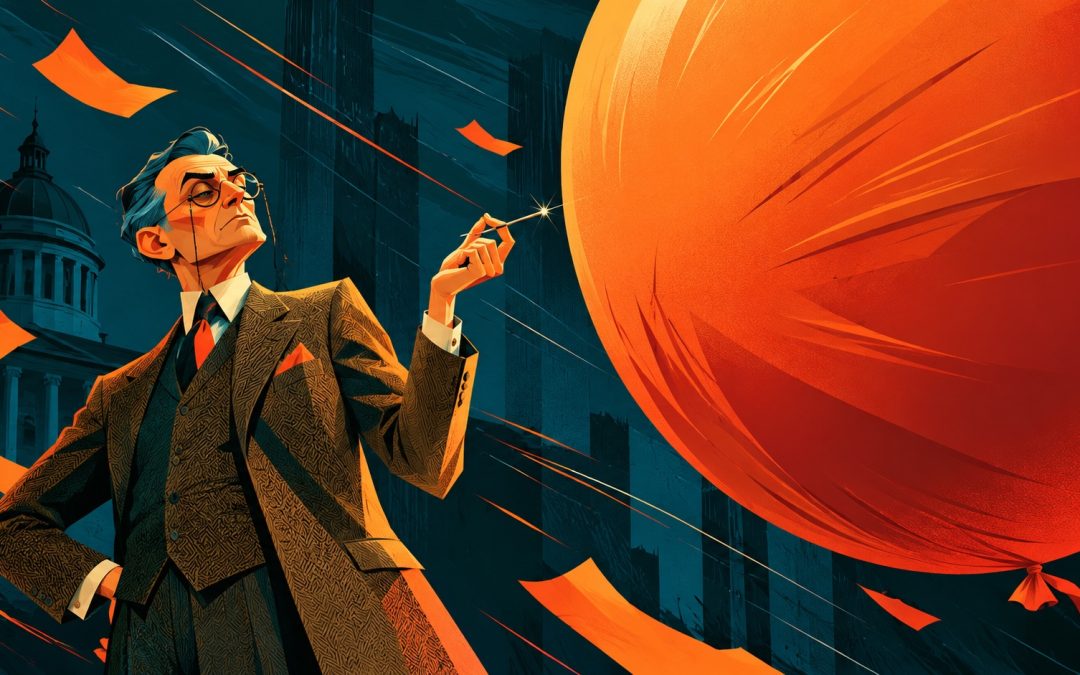
Which leaves an enormous balloon of pomposity floating invitingly in front of the snipers, detractors and mickey-takers.
First target: prick it.
The pacifist Religious Society of Friends became Quakers because, well, they quaked.
Tory came from an Irish term associated with outlaws. Whig was an insult too.
And then there were the Shakers.
What you believe you have founded: The United Society of Believers in Christ’s Second Appearing.
What people see: You shake.
What you’re called 250 years later: Shakers. (Stifled giggle.)
The bloke down the pub
This is the great advantage enjoyed by the mocker, the derider.
He has no obligation to understand your manifesto.
He has no obligation to do anything of use, except that one thing that will secure him his legacy.
All those theories, qualifications, lofty intentions and carefully chosen words can be collapsed into the one observable fact some bright spark down the pub would shout across the room.
Right place, right time, right sense of contempt.
It looks like cubes. It’s cubist.
It’s opera sponsored by soap.
Youth-orientated fun alcoholic drinks?
Alcopops, you mean?
The entire universe started at one moment?
What, like a big bang?
Cue laughter.
Mockery is an extraordinarily efficient form of communication because it searches for the shortest possible distance between the grand idea and what everyone can plainly see.
And once it finds it, the grand idea has a problem.
The joke is easier to remember.
Careful what you call it
Which is why the p***-takers should occasionally be careful with their weapon of choice.
President Donald Trump wants an overblown Triumphal Arch near Arlington National Cemetery. Critics and journalists have inevitably reached for the obvious nickname:
Yes, it neatly captures what critics see as the grandiosity of the project. Yes, it ties the monument indelibly to the man behind it.
But perhaps think about that second bit.
Because if you wanted to build an enormous monument and have people associate it with your name for generations, having your detractors spontaneously name it after you would not necessarily be the worst outcome. In fact, it’s the point.
Two hundred years from now, tourists may have no idea who first thought “Arc de Trump” was terribly clever but they may ask their Subcutaneous AI Daemon who Trump was and why he was so celebrated.
Job done.
Posterity is cruel.
It also has a lousy sense of irony.