
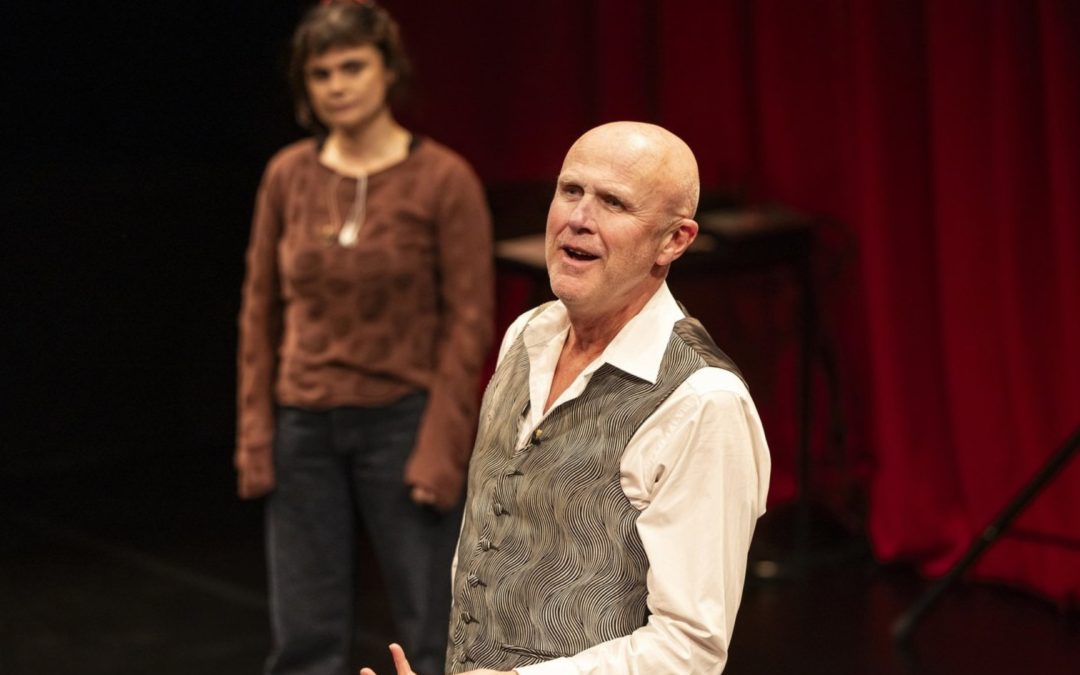
Tim Crouch’s ingenious theatrical experiment fascinates and frustrates, exposing the mechanics of performance at the expense of human drama.
My oak tree will be different to yours. Mine was autumnal and mournful. Yours might be lop-sided and comical.
But they will have plenty in common too.
One constant is writer-director-svengali Tim Crouch, who has been running these events for so long he is more forest ranger than actor these days. Since 2005, he has been collecting A-listers to accompany him on stage. This time he has lined up a roster that includes Juliet Stevenson, Olivia Williams and Suranne Jones.
He burns through his Rolodex because each actor can play the part only once.
For those feeling queasy about improv spontaneity, it’s worth running through the rules. The actors know nothing about the part they are to play. They are fed lines and directions by Tim. He tells them what to do or gives them slabs of script.
The set-up is this: Crouch plays The Hypnotist. This night, our night, we’re in a pub for his latest show. He’s all sequinned jackets and end-of-pier gags, but the performance is decidedly sub-optimal. He’s lost his mojo.
The reason being, three months ago, he hit a young girl with his car. She’s dead. In comes Andy, 42, who volunteers as one of his stooges. Andy, it turns out, is the girl’s father – and he has questions.
Wowser. Great premise. Cling to that. It’s an anchor.
How little we know
Andy, in our case, is Gwyneth Keyworth, the Welsh actor known for TV work like Death Valley and, on stage, To Kill a Mockingbird.
At the beginning she knows as much about Andy as we do and she has to create him as she goes along while we all gawp. She deserves every plaudit because it is a thrilling examination of her craft.
Now we’re leaving the land of rules and conventions and entering the world of deconstructed performance. Into the woods we go…
Because you’re never far from a reminder that this is not business as usual. This is not The Mousetrap or Hamlet where the play is the thing.
- Review – Conflict of Interest is a razor-sharp noir delight
- 9 tricks in the Bayeux Tapestry that film-makers would recognise today
Example: As an aside, Gwyneth might be telling Tim how she’s doing, whether she’s comfortable with the experiment or not – but she’s reading her reaction from a script. So he’s not really asking her and she’s not really telling him. And it’s not really an aside.
That kind of thing.
There are many layers: there’s Gwyneth, the actor, and Tim, the director; there’s Gwyneth and Tim, the scripted versions of themselves; and there’s The Hypnotist and Andy, the parts they play. Sometimes they are all three at once.
Look up “meta” in the dictionary and it might read: We give up, go and watch An Oak Tree and figure it out for yourself.
How much is missing
Instinct wants you, the audience, to make the tragedy into a seamless sequence of consequences and outcomes. You’re grabbing, hand outstretched, at a nub of drama through a thicket of barbed wire, each scratch a jolt back to reality. Instead of the suspension of disbelief there is theatre and script and actor and performance.
And that’s the paradox. The more fascinating the theatrical experiment becomes, the harder it is to engage with the human story at its centre.
Surprisingly little gets done in terms of confrontation, exploration and catharsis. The interplay between killer and parent is underplayed and underwritten. Partly because Andy isn’t quite himself. He’s Gwyneth, obviously, but he’s also a man under hypnosis, creating someone else entirely.
So, in the end we have this Lloyd’s Building of a performance, all the internals on the outside: the ducts, the sewage pipes, the scaffolding. It leaves you uplifted and engaged and frustrated. It is beautiful and ugly.
Crouch shows us how the whole thing comes together. The price is that we stop being an audience and instead become mechanics, watching the works and looking for leaks.
An Oak Tree runs at The Other Palace theatre until 15 November.
This review first appeared on The Spy In The Stalls.