
How a 1,000-year-old masterpiece uses momentum, montage, visual tricks and dramatic structure to tell a story that still feels modern.
The Bayeux Tapestry is nearly 1,000 years old, 68 metres long and made from linen, wool and thread. It is also, in places, like watching a film.
A thousand years old, and you’ll recognise the techniques.
Some are obvious.
There are recurring characters. Establishing shots. Captions. Changes of scene. Reading left to right. Momentum to a climax.
Also, it looks like an unspooled film, or a comic book, which is a give-away.
But there are also brilliant story-telling tricks that go deeper, that trigger psychological responses beyond the conscious mind.
None of which means that the artists behind the Bayeux Tapestry invented cinema nine centuries early. The point is almost the opposite. Storytelling presents the same challenges and opportunities whether you have a camera, a printing press or a needle.
The beauty is: storytellers keep arriving at similar solutions across the millennia.
Look at the Bayeux Tapestry as a story rather than simply a historical artefact and it becomes exhilaratingly modern. It still works.
First, what is the story?
We’re talking about the tapestry because it has taken a once-in-a-lifetime trip back to the land of its creation at a special exhibition at the British Museum.
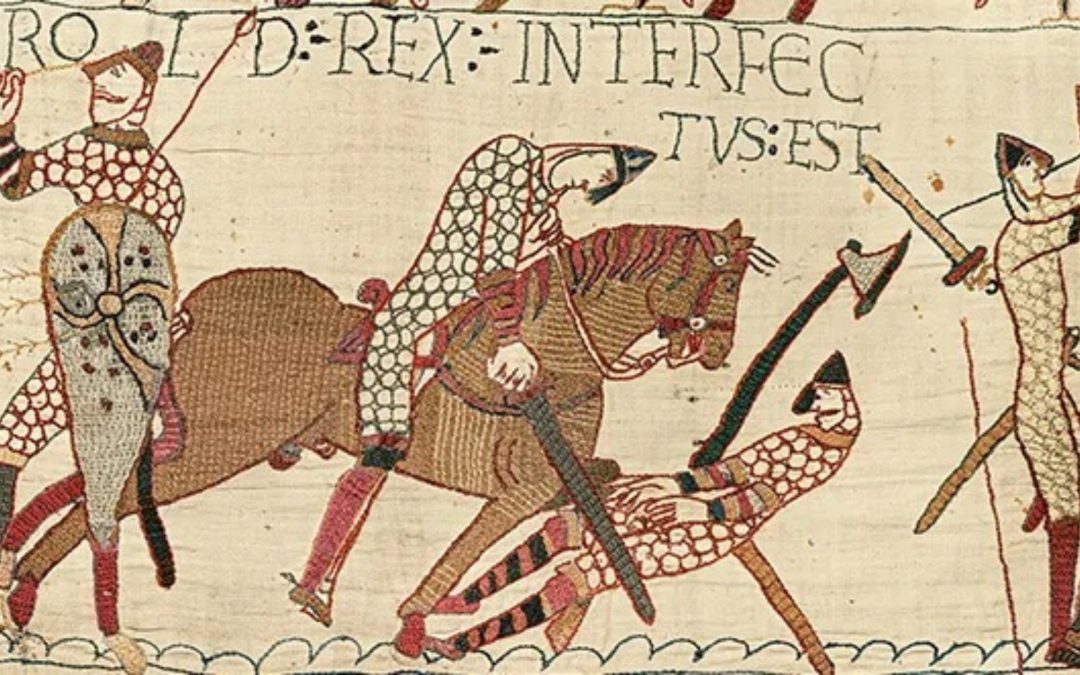
The Tapestry (technically an embroidery) tells the story leading to the Norman Conquest of England in 1066, largely from the perspective of the victors. It was made in England somewhere around 1072.
Its cast includes Edward the Confessor, the ageing English king; Harold Godwinson, the powerful English nobleman who succeeds him; and William, Duke of Normandy, who believes the English throne has been promised to him.
Early in the Tapestry, Edward sends Harold on a journey. Harold crosses the Channel, is captured, is released into William’s company. They become friends and eventually Harold swears a solemn oath to William.
Precisely what this meant remains one of the great historical arguments surrounding the Conquest, but the Tapestry’s dramatic purpose is much clearer: the oath matters. Possibly it is Harold promising William the English throne when Edward dies.
Harold returns to England. Edward dies. And it is Harold who accepts the crown.
William hears about this betrayal.
Everything changes.
Ships are ordered. Trees are cut down. Timber is shaped. A fleet is constructed. Weapons, armour, food, men and horses are loaded aboard. The Normans cross the Channel and land in England.
Then the two sides meet at Hastings.
The result is one of the most famous battles in history – 1066 and all that: Harold is killed – the arrow in the eye – the English flee and William’s path to the English throne lies open.
The rest is, literally, history.
The surviving Tapestry ends abruptly during the English retreat. Its original ending has been lost. It probably continued further, perhaps as far as William’s coronation.
That’s the history. But look at how the story is told.
1. It is basically a 68-metre comic strip
The most fundamental trick is also the easiest to overlook. The Bayeux Tapestry is sequential.
You read it predominantly from left to right. One event leads into another. Characters disappear and reappear because time has passed. Harold isn’t represented by one little Harold who physically travels along the linen. We see Harold in one situation and then see him again further along in another.
That sounds obvious to us because a century of cinema and several centuries of comics have made us fluent in sequential images. But it is a sophisticated convention. The viewer understands that repeated representations of the same person don’t mean there are suddenly two Harolds. They mean: this is Harold, only later. There’s a new dimension – time.
And the Tapestry doesn’t always provide anything resembling the hard rectangular borders of a modern comic panel. One scene can bleed into another. Buildings, trees, gestures and changes in the direction of figures provide punctuation.
Sometimes a character can effectively belong to the end of one visual episode while the next is already beginning around him. The eye makes the edit and the aim is keep you moving forward.
Momentum is everything. This is a thriller after all.
2. The borders are a second screen
The borders are a genius addition.
Running above and below the main story are borders containing birds, animals, mythical creatures, agricultural scenes, fables, jokes, sexual and ribald imagery and various other oddities.
What do they all mean?
No-one is entirely sure. Some may be symbolic. Some may comment on the main action. Some may invoke stories or fables familiar to a medieval audience. Some may simply be decoration.
But collectively they create something rather like ambient narrative.
Imagine watching a film while half-noticing the television playing in the corner, the poster on a wall, a song on the soundtrack or the news report playing behind the dialogue or even the colour of the production. None of those things necessarily advances the plot. But they can affect how you experience it.
Or think of our modern habit of two-screen viewing: watching a film while simultaneously looking up an actor, a historical reference or something the film has prompted us to wonder about.
The analogy isn’t exact, because the Tapestry’s makers have chosen the second-screen material for us. But the principle is similar. The central register says: this is happening. The margins provide a surrounding field of associations: here are other things to have in your head while it happens.
At other moments the borders behave almost like B-roll. They accommodate incidental action, physical detail and aspects of the world that enrich the main narrative without requiring the story to stop and explain them.
The borders are not just a frame. They are additional bandwidth.
3. When the story gets bigger, it busts the frame
And this is where the borders become particularly clever.
Most of the time the Tapestry maintains a fairly orderly three-part architecture: upper border, main story, lower border.
But when the story needs more room, it takes it.
Look at the Norman fleet crossing the Channel. Suddenly the masts and sails rise into the upper register. The spectacle is too large for the normal dimensions of the story.
In film terms, we’ve gone wide. We’ve pulled back to capture spectacle. We’re IMAX not 16:9.
The border has been commandeered to give the event scale. William isn’t travelling in another little boat. This is an invasion fleet, and the visual language expands to accommodate it.
The effect is almost vertical: ambition, sails, wind and movement push upwards.
Then, at Hastings, precisely the opposite happens.
4. The lower border becomes a graveyard
Earlier in the Tapestry, the lower border is full of life. There are animals, fabulous creatures, people at work, jokes, bodies and appetites. It is a strange, lively world running beneath the official business of kings, bishops and nobles.
Then comes war.
During the Battle of Hastings, the battle begins to occupy that space too. The lower register fills with fallen men and horses, discarded shields and weapons, severed limbs and bodies being stripped.
The border has become somewhere to put the dead.
It is hard not to experience it spatially as beneath the earth. Literally, the border line is above them. They are buried. Above, men are still fighting. Below, the consequences of fighting are accumulating.
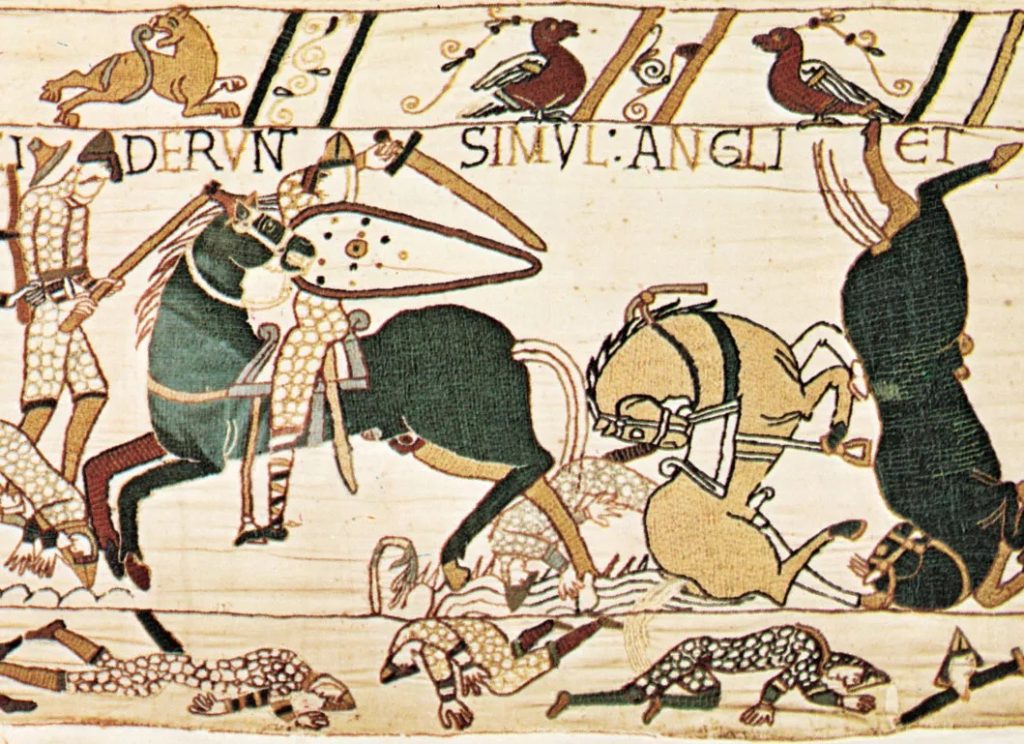
The Tapestry has again commandeered its reserve narrative space, but for a completely different purpose.
During the invasion, spectacle expands upwards.
During the battle, death accumulates downwards.
The story has consumed its own margins. This is kind of meta. The periphery has been drafted in to help out the main narrative panels because the main narrative panels can’t hold the number of the dead. It’s a bloodbath and not even the storytelling conventions of the tapestry itself can hold. It’s that bad.
5. Left to right means: we’re going somewhere
The Tapestry also understands something film-makers still exploit: direction creates psychological momentum.
Because we follow the narrative from left to right, that direction gradually acquires meaning. Movement towards the right feels like progress through the story.
→ → →
Figures travel. Horses ride. Ships sail. Events advance all the time.
Opposition can therefore face the other way.
→ ←
Someone facing left isn’t simply looking in another direction. Within the visual grammar established by the Tapestry, they can appear to be facing against the story. They are the obstacle.
There is an interesting twist to this. The geographical journey changes direction. Harold travels from England to Normandy; later William travels from Normandy to England. If the Tapestry were behaving like a map, those journeys ought to run in opposite visual directions.
They don’t have to.
The Tapestry isn’t primarily mapping geography. It is mapping narrative momentum.
Early on, Harold possesses much of that momentum. He travels into William’s world. He goes left-to-right. He has the momentum – that’s the direction we read. He faces the French who face him right-to-left. Opposition and obstacle. A threat to progress.
Later, after Harold has taken the crown, agency passes to William. Now William becomes the mover. He builds, embarks, crosses and advances. He takes over the “left-to-right” driving seat. In the first “acts”, England was on the left and France – the destination – on the right. Now, England is the destination so that is on the right.
The visual baton has been handed over:
Harold → William
then:
William → Harold
Whoever possesses narrative agency gets to move forwards through the story. Subconsciously, we learn the language of momentum. And then it gets upended for a very particular reason…
6. Then the battle deliberately breaks the rules
Having spent dozens of metres teaching us that visual grammar, the Tapestry reaches Hastings and starts messing with it.
The flow deteriorates.
Men face in different directions. Horses turn. Bodies fall. Weapons cut across competing axes. Figures advance and retreat. The visual field becomes increasingly difficult to read as a simple left-to-right procession.
→ ← ↗ ↓ ← → ↙
And at exactly the same time, the neat vertical distinction between main story and border is breaking down as corpses and battlefield debris fill the lower register.
The orderly visual system the Tapestry has spent so much time creating begins to buckle.
Psychologically it screams – chaos!
This is very close to something an action director can do today. Establish clear geography and screen direction, then progressively disrupt it as a fight descends into chaos. Cuts become faster. Angles become less stable. People cross established directions. Sound and movement become confused.
The audience doesn’t merely watch people becoming disorientated. The visual language makes the audience feel some of that disorientation. After settling into our comfortable reading pattern, we become woozy and disorientated. We get a small experiential glimpse of the Battle of Hastings.
Again, we shouldn’t pretend the Tapestry’s designer had an 11th-century theory of cognitive psychology. You don’t need one to discover that orderly movement looks orderly and colliding bodies, diagonals and opposing directions look chaotic. That’s what you’d instinctively do. Ask a child to draw a car crash and there are crayon strokes everywhere.
The result is the same.
For much of the Tapestry, the visual grammar tells the story.
At Hastings, the “director” co-opts the visual grammar itself to convey an emotion.
7. Harold’s coronation is a terrific midpoint
There is another strangely familiar feature. The story has structure.
It isn’t simply: this happened, then this happened, then this happened.
There is cause and effect.
Early events establish relationships and obligations. Harold encounters William. Harold swears his oath. Harold returns home.
Then Edward dies and Harold is crowned.
It is a superb dramatic pivot because it changes the meaning of everything that has come before and determines everything that follows.
Before the coronation, the story is largely about diplomacy, succession and promises.
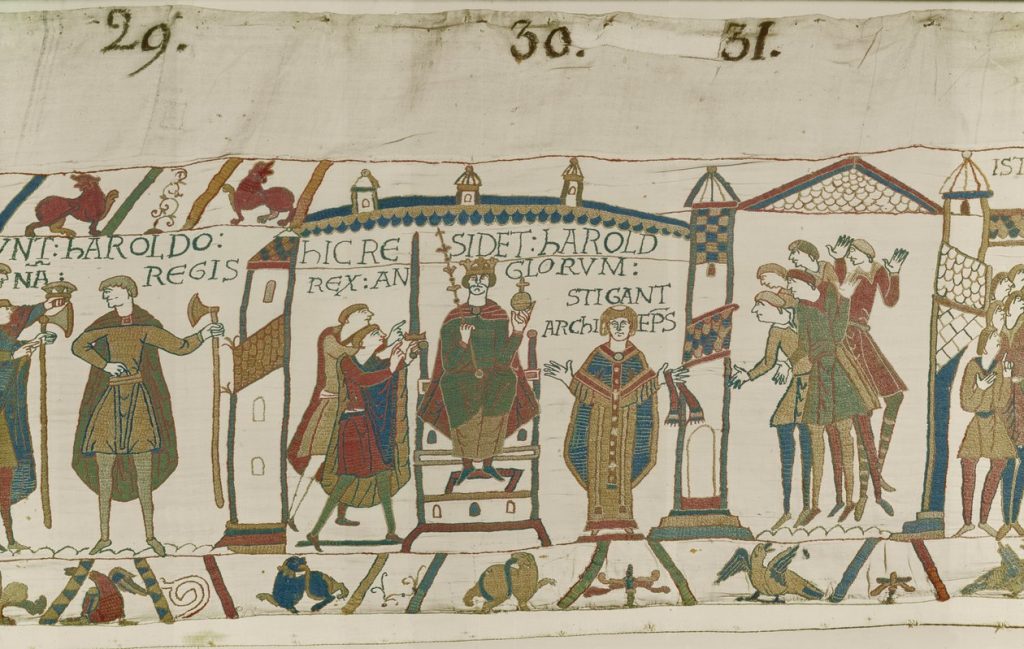
Afterwards, it becomes a story about consequences.
In a modern film we might call it the midpoint reversal. The protagonist has made the choice from which the rest of the plot follows.
And somewhere across the Channel, William gets the news.
Uh-oh. There’s no going back now.
8. Cue the preparation montage
What happens next would be instantly recognisable to a modern cinema audience.
William decides to act.
But first he needs a montage! Gathering his tools, equipment, and his team together. Bolstering his nerve and his resources. And, crucially, signalling to the viewer that something big is coming. The showdown is coming. This isn’t a light skirmish or a sub-plot, this is what we’ve been waiting for.
This is the final attack on the Death Star. This is Rocky against Apollo Creed.
Buckle in. What we did before won’t be enough. We need to dig deeper.
- Cut to trees being felled.
- Cut to timber being worked.
- Cut to ships being constructed.
- Cut to supplies.
- Cut to weapons.
- Cut to horses.
- Cut to men embarking.
- Cut to sails.
You can almost hear the rousing Rocky-style music.
It is the classic prepare-for-the-showdown montage.
The storytellers face exactly the same problem as a modern director. William cannot simply hear that Harold has become king and appear five seconds later at Hastings with thousands of men. The audience needs to understand the scale of the response and its significance.
But depicting every meeting, procurement decision and afternoon spent hammering bits of Norman ship together would kill the momentum at exactly the wrong time.
So the Tapestry selects representative moments. Show enough and the audience supplies everything between them. The very nature of the cuts – rapid, unexplained – suggests a world of action.
Film montage works on exactly the same principle.
9. It even has something resembling a five-act structure
Impose a modern five-act model on Bayeux and it fits surprisingly comfortably.
- Act I: The mission. Edward, Harold’s journey and the establishment of William.
- First turning point: The oath. Harold becomes bound to William in a way that will matter later.
- Act II: The return. Harold comes back to England and Edward approaches death.
- Midpoint: The crown. Edward dies and Harold becomes king. The underlying problem becomes an active conflict.
- Act III: The response. William receives the news and mobilises. The great preparation montage begins.
- Second turning point: The crossing. William’s fleet sails. Preparation becomes irreversible action.
- Act IV: The invasion. The Normans land, establish themselves and the two forces converge.
- Climax: Hastings. The orderly visual language collapses into battle. Harold dies.
- Act V: The resolution. The English flee and William has won the decisive confrontation.
Except that someone has lost the last reel.
The surviving Tapestry breaks off during the English retreat. We don’t know exactly what followed. William’s eventual coronation is an obvious possibility – the catharsis.
If that was the original ending, it would provide an extraordinarily satisfying bookend: the story begins in the world of Edward the king, passes through Harold the king and concludes with William the king.
The crown would effectively be the object around which the entire story turns.
Storytelling before cinema
There is a danger in all this of getting carried away.
The Bayeux Tapestry is not a storyboard for Gladiator. Its makers did not invent the montage, B-roll, the wide shot or the five-act Hollywood screenplay. Some of our interpretation inevitably comes from looking at an 11th century object with eyes trained by 21st century visual culture.
But that’s also what makes it interesting.
The creators of the Tapestry were facing story-telling challenges, wondering how they could answer problems about anticipation, mood, momentum, chaos using only needle and thread and their imagination.
The wonder of the Bayeux Tapestry is that our story-telling minds and those of a millennium ago grapple with the same problems and come up with similar answers.
The technology changes. But the human urge to create an immersive tale never does.
- The dark secret hidden in Hockney’s most famous painting
- Master the art of storytelling with these 5 simple Cs
That may be why the Bayeux Tapestry can feel so unexpectedly alive. Its anonymous designers understood that a story isn’t merely a collection of important events. It requires selection, rhythm, direction, compression, escalation, anticipation and climax.
You can feel the story-telling instinct emanating from this reel. They really, really wanted their viewers to get caught up in a tale, to feel breathless excitement, to feel tragedy looming, to feel the weight of turning points and the catastrophe of poor judgment.
They had linen and coloured wool.
And somehow, nearly a thousand years later, the result still moves.
Forget history. This is alive today. A breathtaking story captured in thread.