
David Hockney’s sunlit masterpiece looks like an image of beauty and freedom. But look beyond the dazzling colours and something much darker emerges.
David Hockney’s Portrait of an Artist (Pool with Two Figures) always bothered me. I never knew why.
I mean, look at it. The azure blue water, the lush landscape receding into the distance. A young man stands at the edge of a swimming pool, looking down at another man swimming beneath the surface.
It is one of the most famous paintings of the 20th century and feels instantly accessible.
But I always turned away. Didn’t get it. It even irritated me because a painting you should be able to understand.
When David Hockney sadly died, there it was again, all over my screens. That picture.
What was it that bothered me?
Finally, I grasped it.
Menace.
The horror hiding in plain sight
The painting is dripping with menace. Do you feel it now?
Yes, Hockney has dressed menace in the clothes of French liberty, but there it is, literally as clear as day.
Notice how the painting adopts some of the visual tropes of a horror movie.
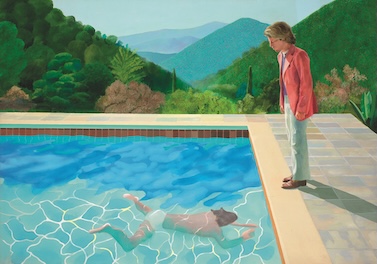
David Hockney, Portrait of an Artist (Pool with Two Figures), 1972. Fair use. Wikipedia

- One man is clothed. The other is almost naked.
- One man stands above. The other is below.
- One is still. The other is moving.
- One is watching. The other appears oblivious to being watched.
This is a classic stalker vibe, I think. That looking downness of the clothed figure. That absolute stillness as the swimmer moves inexorably into his trap. Innocence before the dark.
I’m thinking of an early 1980s slasher film, one of those films in which a beautiful, idyllic location is made terrifying by the presence of somebody watching from the shadows.
And that’s the point. The trick.
There are no shadows.
What happens when the lights go out?
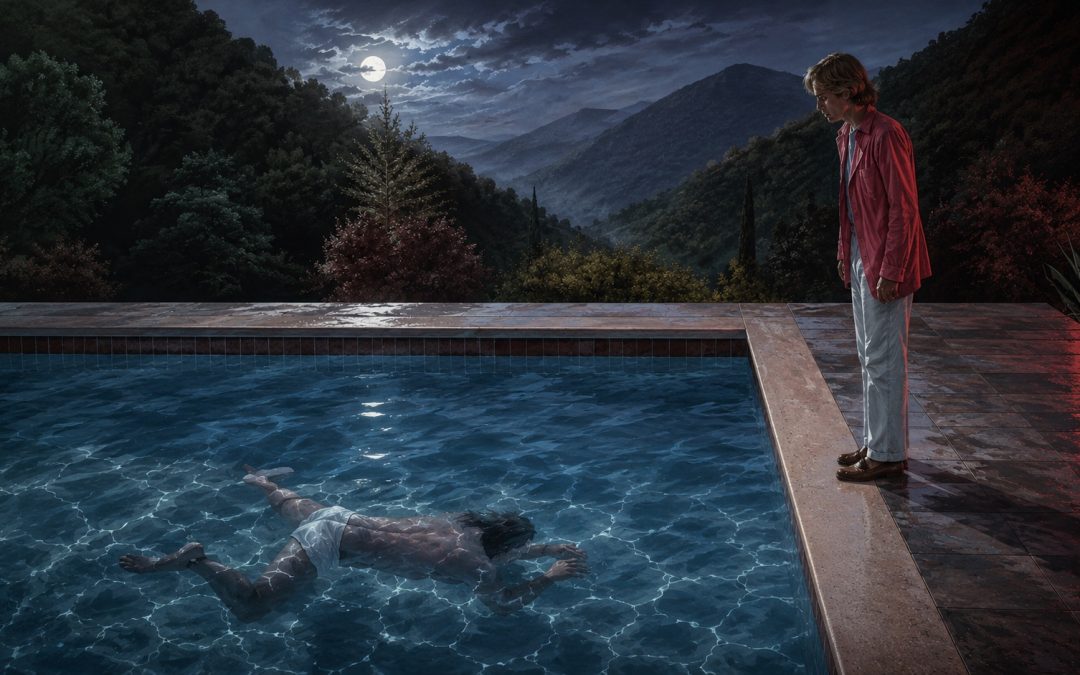
Imagine the same composition at night. As I have done, thanks to AI.
The mountains become black silhouettes. The trees merge into darkness. The water turns from cheerful turquoise to deep blue. The swimmer is illuminated by the pool lights. The standing man becomes a shadowy figure looming over him.
Nothing fundamental has changed.
The two men are in the same positions. The imbalance between them is identical. The swimmer is still vulnerable and the standing man is still watching.
Only the light has changed.
This is what fascinates me about the painting now. Hockney’s colours are doing something extraordinary. They are, in effect, sanitising and disguising the menace. Presenting evil like a pal showing up for lunch.
The colours say: everything is fine.
The composition whispers: something is wrong.
Love, separation and the watcher
Of course, that was not Hockney’s intended story.
The painting was created in 1972, in the aftermath of the end of his relationship with the artist Peter Schlesinger, who is the standing figure. The composition itself developed when Hockney saw two unrelated photographs lying beside each other: one of a swimmer underwater and another of a man looking down. He saw the possibility of a relationship between them.
The usual interpretations of the painting are consequently about love, separation, longing and emotional distance.
And all of that is there.
The two men occupy the same physical space but seem to inhabit different worlds. They dwell in different mediums. The surface of the water separates them. The standing figure can see the swimmer, but the swimmer cannot see him. One watches while the other moves away.
It is an image of emotional asymmetry.
But how many horror movies begin at the end of a failed relationship?
Perhaps the ingredients of menace and the ingredients of lost love are not as different as we might imagine.
The menace was already there
I wanted to see what would happen if the sunlight were taken away.
So I reimagined the picture as a scene from an 1980s horror film. The essential composition remains: the swimmer in the water, the figure standing above him, the mountains beyond. But the scene is now dark, the pool illuminated, the surrounding landscape threatening.
The result is not so much a transformation as a revelation.
The menace was already there.
That does not mean Hockney secretly painted a horror picture, of course. It means that pictures, like stories, contain possibilities their creators may never have intended.
We, the viewers, bring our own interpretation.
And Hockney’s paintings are especially good at presenting imagery as, excuse the pun, blank canvasses.
All those still figures he painted in stately diffidence, never quite connecting with each other. Onto those figures we impose a story, as we always do.
His paintings are especially good as Rorschach tests. We see not only what is there, but what we bring to what is there.
That is why all good art, books, poetry, painting, sculpture, architecture, feels personal. The artist brings the content and we bring the baggage.
We can’t help ourselves.
That’s why my Portrait of an Artist (Pool with Two Figures) is, no doubt, very different from yours.
But go on, admit it.
Now you’ll never be able to unsee the menace.
The painting is dripping in it, isn’t it?