
Alexi Kaye Campbell’s drama traces Mary Ann Evans’s rebellion, setting the future George Eliot against faith, family and convention.
As a debate rages about the death of reading, award-winning playwright Alexi Kaye Campbell comes at us with an easily digestible and endlessly spirited primer on George Eliot.
This new play comes bookended with a slice of drawing room farce at the beginning to ease us in – think Malvolio courting Elizabeth Bennet – and a curiously on-the-nose coda at the end. This is in case we still haven’t figured out that headstrong Mary Ann Evans is destined to become the author of Middlemarch under a gender-swapping nom de plume.
For the most part, though, this is an engrossing and serious study of a young woman loved and wronged repeatedly; a victim of her age, her sex and her voracious curiosity.
Bird Grove and the battle of wills
To 1840s Coventry then, and Bird Grove (the house), for this fact-based origin story.
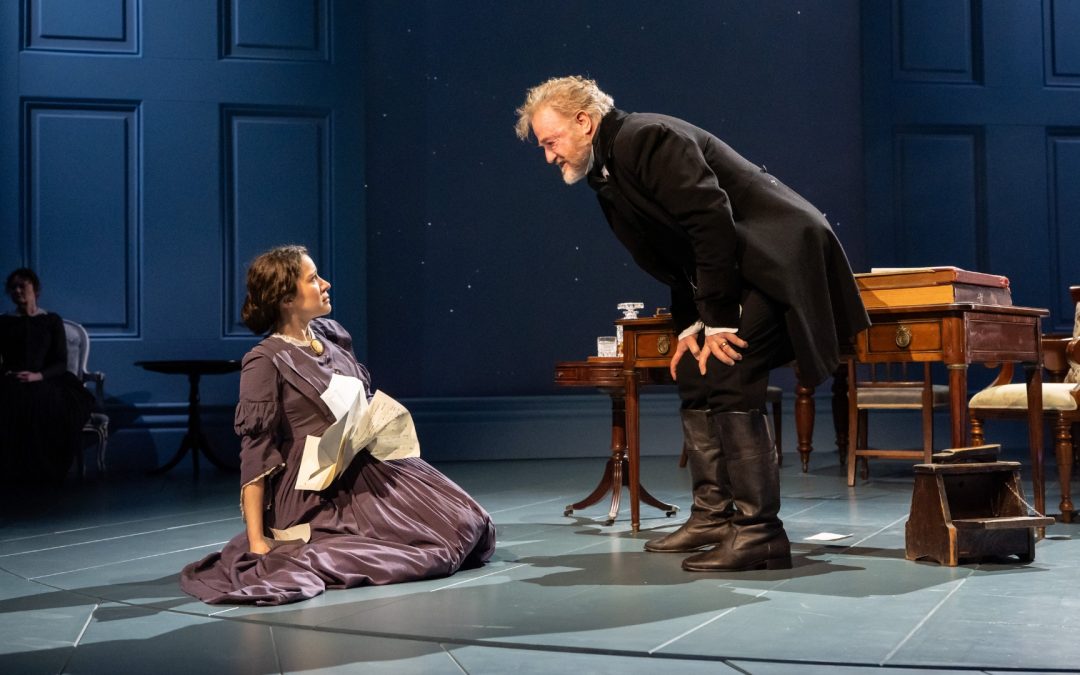
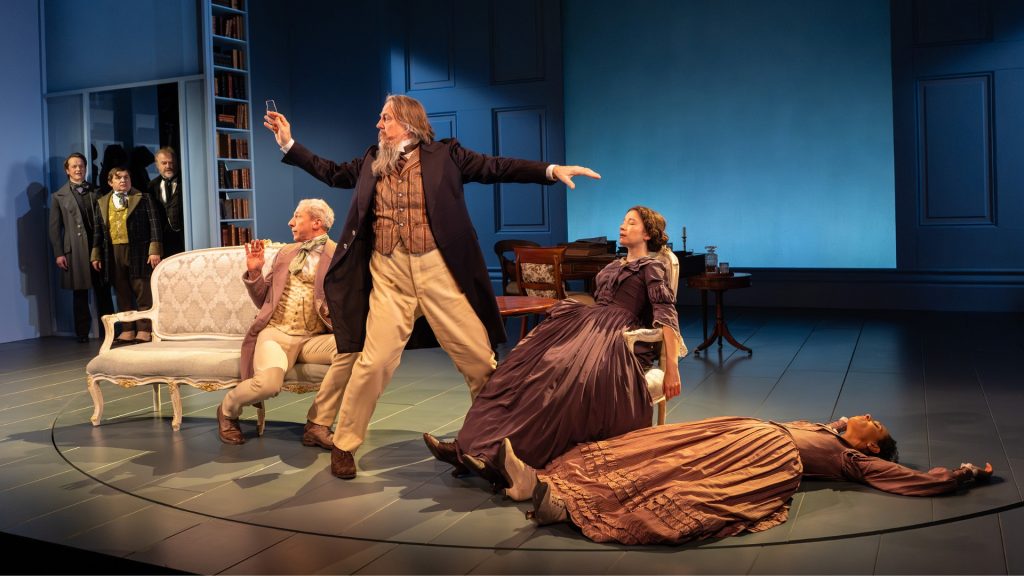
The setting (Sarah Beaton) conveys an elegant five rooms simply devised on a rotating stage. This is the home of Robert Evans (Owen Teale) who has worked all his life to acquire such a property, a bowerbird’s nest in which to show off his unmarried daughter Mary Ann (Elizabeth Dulau).
But bird’s fly and nests are emptied, and that is certainly in the mind of Mary Ann who decides one day, after much turmoil, not to accompany her father to church. She doesn’t believe in the dogma of religion nor the marketplace of singletons.
The declaration is shocking.
In the face of this stand, one is stubborn, the other is wilful. And vice versa.
They are barely separate creatures in that regard.
A father who sees more than he says
Despite the fissure, there is always a chance of rapprochement. It is beautifully touching that twice widowed Robert Evans is exasperated and infuriated by his daughter’s defiance – but also proud in his own contained way.
He is a simple man, plain spoken, a grafter of no great insight. Except in this matter.
When smug allies and “free thinkers” Mr and Mrs Bray (Tom Espiner and Rebecca Scroggs) try to arbitrate, they list Mary Ann’s many talents. He has the perfect riposte to their snobbery.
“You are intelligent people and astute at least in spotting my daughter’s genius, but how astounding that you have not entertained the notion that I have spotted it myself.”
It’s true. An estate manager by profession, he knows how to rescue pigs from their own muck, but he also knows what possesses his daughter, even though he cannot fully come to terms with her significance.
Performances at the core
Despite a nine-strong cast, the play is a classic double act of opposites – young and old, parent and child, traditional and progressive – rendering the early toilet troubles of silly suitor Horace Garfield (a winning Jonnie Broadbent) and other farcical diversions into something forgettable.
- Review – The Virgins leaves the bathroom door ajar so we can hear the girls talk
- Review – Living with Kenneth Williams is no joke
The chemistry, diffidence and opposition of father and daughter is key. Owen Teale as Robert is a towering man, a thunderous spirit and yet strangely uncertain for much of the play. But he discovers a resounding and unshakeable timbre when his convictions are truly challenged.
And Elizabeth Dulau as Mary Ann is as bright and fresh as the country morning – perspicacious, revolutionary, chafing at the yoke and aching to meet her destiny. If Dulau wasn’t a star already – thanks to Andor – this performance would bring her to notice. She embodies the duel of duty and ambition but retains crystal clarity throughout.
Flourishes and flaws
There are some quirks in the production – the language is a hybrid of formality and modern idioms and the business with the French mesmerist (James Staddon) seems – again – unnecessary. Meanwhile, Anna Ledwich’s graceful direction can sometimes become stilted.
But this is a confident production, keen to entertain and doing so with ease.
Bird Grove is showing at Hampstead Theatre until 25 March 2026.
This review first appeared in The Spy In The Stalls.