
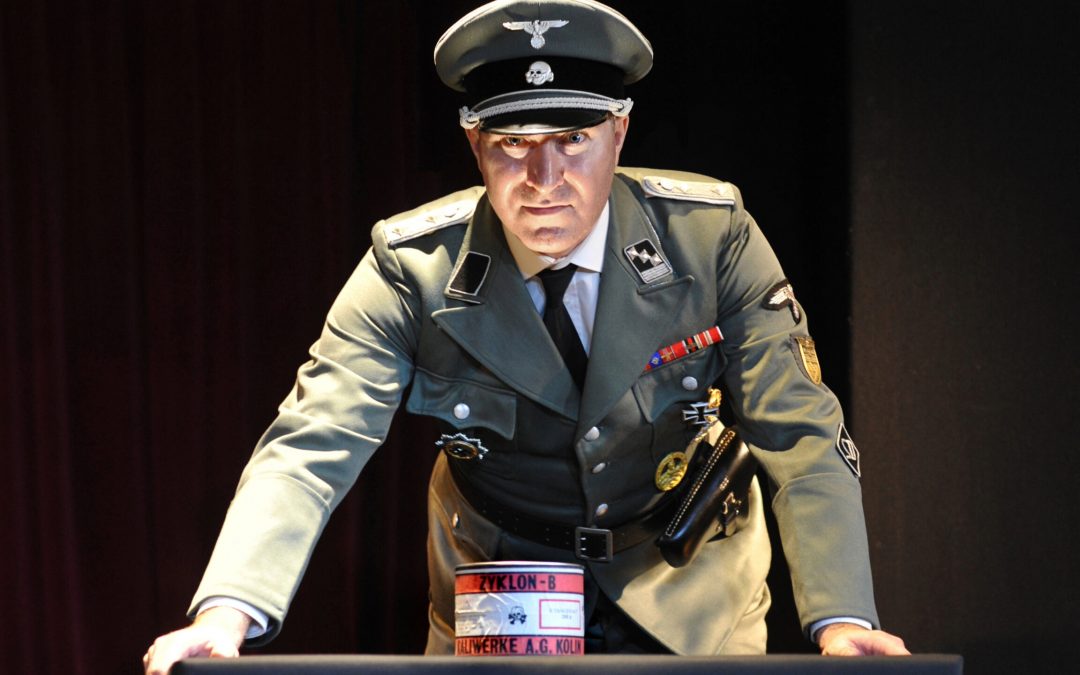
James Hyland’s testing quasi-monologue strips genocide of drama, exposing how familiar the language and logistics of mass cruelty feel.
Auschwitz, 1941.
Topical?
On the day this quasi-monologue was staged at the White Bear Theatre, The Washington Post reported that US Immigration and Customs Enforcement was acquiring a series of sprawling industrial warehouses in at least eight states.
One, a former auto parts distribution centre in New York, becomes unbearably hot in the summer. Two former workers say so.
The purpose of those buildings?
Mass detention.
The comparison is crude and dissonant. But it also will not go away. Because the most striking legacy of this brutish Brother Wolf Production is our casual familiarity with the infrastructure, process and language of hate.
We know all about the lexicon of otherness, talk of tainted blood, of criminal races, of the necessary elimination of the enemy within and the means by which such a goal might be achieved.
Here and now
Writer-director James Hyland’s nasty lecture reminds us that the past is not a foreign country.
This short, sharp shock of a piece is based on true events. Hyland is Rudolf Höss, Commandant of the Nazi concentration camp known as Auschwitz. He has assembled his SS personnel – us – to a secret meeting with the express purpose of unveiling Hitler’s final solution to the Jewish question – extermination.
No more ghettoes, emigration, detention. Instead, elimination.
Auschwitz will become the “largest human slaughterhouse in history”. All this is done for the protection of German blood and carried out under the law.
And we are the accomplices, we are the secret holders, we are the SS and Hyland looks into our eyes to see whether we have the requisite steel to carry out this most favoured project.
It is disturbing.
But not as disturbing as the treatment of Howard Konisberg, an escapee, who stands there in his “striped pyjamas” complete with crumpled Star of David and his number, 1-26947.
- Review – Living with Kenneth Williams is no joke
- Review – The Comedy About Spies, shaken, stirred and silly
He is there as guinea pig and exhibit. Höss insists on showing us how a Jew must be treated. He systematically tortures the man, close to death. There are 25 strikes with a whip. Count them, because Howard has to and we must too.
Ashton Spear (who plays Howard) must weep, howl and crack and he does so with a sickening, gut-wrenching potency. Count them, those 25 strikes over 15 of the most difficult minutes I have spent in a small theatre space.
The whole production is less than an hour because who can stand any more? It is nauseating.
Hyland, as Hoss, is cajoling, menacing, terrifying, charming. He sells poison as cordial.
Present and incorrect
Sometimes he screams with the dangerous light of the zealot in his eyes, other times he sounds like your sing-song boss hosting a PowerPoint on sales growth in Quarter Four.
He presents the killer gas Zyklon B as your line manager might a new AI sales platform. Think of the productivity benefits! What we can accomplish in a fraction of the time!
Yes, there is a mild twist at the end which results in the prisoner making a telling point and Höss – not in the least bit credibly – having a flicker of doubt. But it counts for nothing. We know how it ends. He lives in a villa inside the camp with his five children and, over the barbed wire fence, 1.1 million are murdered.
A Lesson From Auschwitz is crisply executed, powerful and deliberately gruelling. But it is not a piece of entertainment. There is no consolation to be found here, and there never should be.
A Lesson From Auschwitz was presented at the White Bear Theatre, Kennington.
This review first appeared on The Spy In The Stalls