
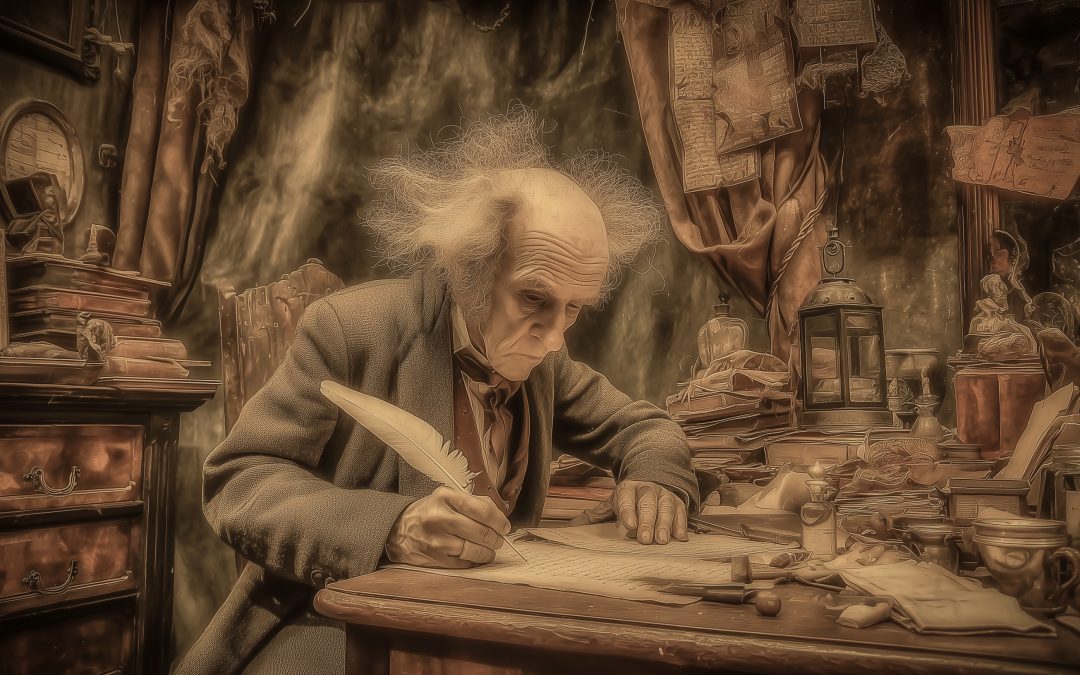
A Christmas Carol became definitive through tight structure, unforgettable characters and a hopeful arc that is relevant to our own busy lives.
It has become the Christmas story, hasn’t it?
No, not that one, the weird origin story with a gum resin called myrrh and Herod’s regressive tax strategy.
But Charles Dickens and A Christmas Carol.
This isn’t a slight on scripture – although our era may find an overtly religious tale problematic.
No, it’s something to do with how A Christmas Carol behaves as a story, how its texture, beats, mission and technique are hard-wired to deliver us the festival feels.
(By the way, Scrooge’s journey isn’t entirely unlike that of Jesus. He descends, confronts darkness, and returns transformed, offering redemption to others. But then again, aren’t all great stories versions of the same old pattern, retold in new clothes until we recognise ourselves in them?)
And this isn’t about what Dickens did for our ultimate image of Christmas. This is what the writer does under the hood.
The other half is structural. Dickens built a narrative that taps into universal fears, longings and regrets, packaged in a way that flows with almost mechanical precision, even though (joy of joys) it never feels mechanical when you’re reading it.
A Christmas story about a fear most of us share
A Christmas Carol is a story about a question every adult recognises: what if I’ve wasted my life? It is a year-end story as much as a yuletide tale. A pause before we go again – with a renewed vigour and ambition.
You don’t need to be a miser to feel that needling sense of panic as the clock ticks on. It creeps in quietly as childhood ideals drift away, replaced by habit, disappointment or compromise. Dickens understood that this fear is evergreen. It renews itself every year, just like Christmas.
That’s the real inciting incident. Not Jacob Marley, not the rattling chains, but the moment the reader recognises the shape of their own anxieties in Scrooge.
A lifetime in one night
The more I revisit the book, the more I appreciate the elegance of Dickens’ compression. An entire emotional lifetime squeezed into a single night. Not a sprawling novel but a life in tiny snippets. It’s a simple idea, but it means every encounter, every beat, every memory lands with weight because the clock is always ticking.
The three ghosts – past, present, future – what a genius conceptual device.
Instead of having Scrooge reflect on his life – on his own and unaided – Dickens externalises those reflections. Regret, guilt and hope walk into the room. They grab him by the elbow and drag him on. As a structural move, it’s brilliant: it gives you momentum, pressure and focus all at once.
All in a tight 30,000 words (about three hours’ reading time). A Christmas Eve essential before the festivities begin. God bless us every one!
The clean three-act frame
Once you see it, you can’t unsee it. The book has a classic three-act frame:
- Act one: Scrooge as he is. Locked-down, lonely, fragile under the armour.
- Act two: the confrontation. And here Dickens uses one of the most satisfying patterns in storytelling: the rule of three. Three ghosts. Three perspectives. Three escalating truths. The past explains him, the present exposes him, the future frightens him. They’re like three nested act twos, each doing a different job. A tryptic of moods: Nostalgia, mind-opening, terrifying. A tryptic of contrasts, soft hues, bright colours, and dashed (back) into the dark.
- Act three: the dawn. Not simply a resolution but a demonstration. You see the change in motion, not in theory. Change is possible.
The design is surprisingly tight for something often treated as a cosy fable.
Characters as guides through the maze
And, of course, the story works because Dickens gives you reasons to move forward. Structure alone is never enough, you need characters who act as emotional signposts.
Scrooge is compelling because he’s both awful and understandable. He’s the hook that pulls you through the structure by force, because you want to know whether he can change or if he’ll crack. Tiny Tim, on the other hand, is all sympathy and emotional shorthand. He’s the beating heart that keeps the stakes high.
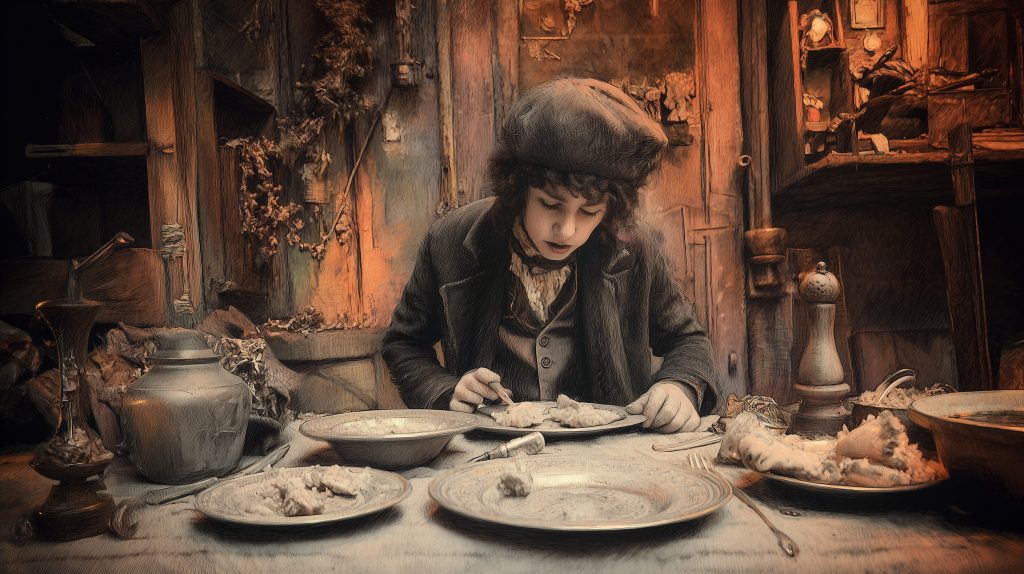
Tiny Tim
Life or death, in his case.
And the ghosts themselves are guides in the most literal way. They shepherd Scrooge, and us, through the story’s architecture. They open the doors, set the pace, raise the emotional pressure. They’re not just plot devices; they’re escorts through the narrative maze.
Without these figures, the structure would be clever but hollow. With them, it becomes something you feel rather than admire. The story drags you along by your heart as much as by its clockwork.
All the major paradigms in play
Part of the reason the tale feels so complete is that it touches almost every major narrative paradigm:
- Conflict (Scrooge versus himself, society, time)
- The struggle for meaning (what’s a life for?)
- Hope (change is possible, even now)
- The distance between childhood ideals and adult reality
- Moral awakening without moral lecturing
It gives you the whole sweep of the human condition in a compact, festive parcel.
A story that feels instinctively right
All this creates a package that feels completely right. Everything lands exactly where you expect. The ghosts appear at the right moment, the revelations escalate, the emotional burden deepens, the mood darkens and then lifts.
- Review – Havisham, the haunted origin story of an icon
- How a Bucket shaped detective fiction’s greatest traditions
It is modern in its pacing (unlike a lot of Dickens). That’s why Bill Murray, Mr Magoo, the Flintstones, the Muppets et al (50 film versions alone) have taken up the text and added their own curl and interpretation.
Why it has overtaken the nativity as the Christmas story
The nativity gives us meaning. Dickens gives us meaning and narrative propulsion. The nativity invites reverence; Dickens invites personal reflection. The nativity is just a bit abstract – taxes and donkeys and shepherds; Dickens says, Scrooge’s life is your life, give or take.
The clock is ticking. But it’s not too late.